
Sustainability Report 2025
A message from our sustainability lead
At IOP Publishing, we are committed to building a more sustainable, diverse and equitable future for the scientific community we serve. Sustainability is embedded into every aspect of our business; from the decisions we make as a publisher to the way we operate as an employer.
Since 2020, we have worked hard to understand our full environmental impact, identify the areas where we can drive real change, and track our progress transparently.
This year, we are proud to report a 36% reduction in carbon emissions as compared with our 2020 baseline, reducing our footprint and ensuring responsible business practices.
Our move to The Distillery in 2022, our new, energy-efficient head office based in Bristol, marked a major milestone in our sustainability journey. Although the transition caused a short-term rise in emissions while we operated two sites and fitted out the new office, the new space is designed for long-term efficiency and overall, a much lower environmental impact.
In parallel, our digital-first publishing strategy continues to deliver substantial emissions savings across the content lifecycle. We are also beginning to see improvements in our supply chain where we actively engage with vendors to support and accelerate their own sustainability journeys.
None of this progress would be possible without the commitment of our colleagues including our Sustainability Taskforce and Champions and the support of our suppliers and trusted partners such as ClimatePartner, and the insights gained from industry initiatives like DIMPACT. Together, we are continuing to transform our operations and contribute to a more sustainable future for research publishing.
Liz Martin, Head of Content Production and Sustainability Lead


Our strategy
At the heart of our drive for greater sustainability lies our environmental policy, which guides how we reduce our impact, aiming to exceed regulatory expectations and embed environmental best practices across our business. It includes commitments to:
- Minimize greenhouse gas emissions across our operations and supply chain.
- Improve energy efficiency in our facilities and adopt renewable energy where possible.
- Reduce waste and promote circular practices, including recycling and responsible resource use.
- Engage suppliers and partners to align with our sustainability standards and report on their environmental performance.
- Continuously monitor and improve our environmental impact through transparent reporting and measurable targets.
These commitments are supported by organizational measures including recycling schemes, sustainable procurement, green transport incentives, energy and water monitoring, and our active Sustainability Taskforce.
Sustainability Taskforce
Aligned with our commitment to Publishing Declares, the Sustainability Taskforce leads our efforts to reduce environmental impact and embed best practices across the business. It is framed around four key areas of focus:
- Carbon emissions reduction
- Supply chain management
- Content and products
- Colleague engagement
As part of the Taskforce, our Carbon Footprint Working Group collects data throughout the year on activities such as energy use, print volumes, travel, waste and employee commuting. This data is processed by ClimatePartner, which applies emission factors, calculates our footprint, and provides analysis of our hotspots and recommendations for reduction. They have also supported us in modelling our net zero trajectory so we can stay on track.
We also participate in DIMPACT, a project driving industry-wide focus on understanding the emissions associated with digital activities. This year, DIMPACT launched Working Groups focused on Academic Publishing and AI, both of which we actively contribute to.
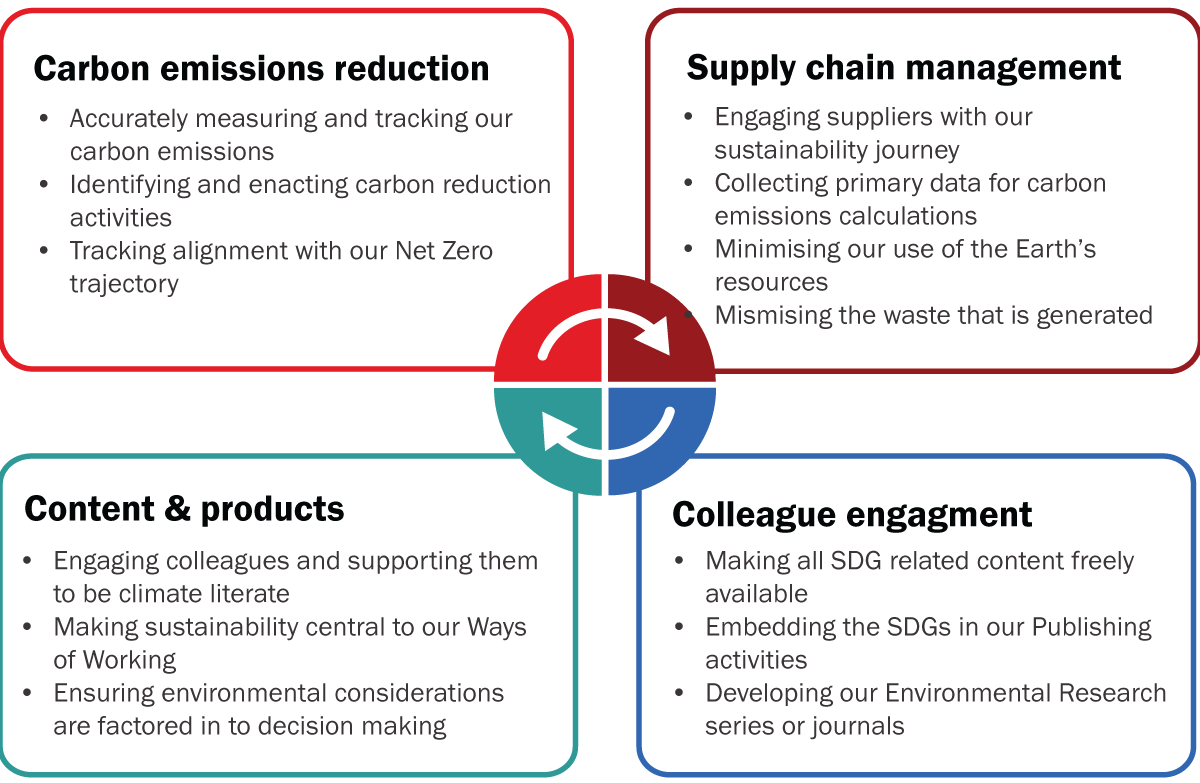
Our Supply Chain Working Group is focused on engaging our suppliers on sustainability. The Group sets the expectation that sustainability is a key focus for us and encourages suppliers to prioritize taking action on their carbon footprint and other environmental activities, as well as collecting primary data for our corporate carbon footprint calculation.
“Many organisations are aiming for a 30–50% carbon reduction by 2030, measured against a 2020 baseline. Having already achieved a 36% reduction, IOPP is not just keeping pace with industry ambition, it’s out in front. This progress reflects a genuine commitment to sustainability and is something they can be proud of.”
Marett Howlin
Senior Sustainability Consultant at ClimatePartner
Carbon footprint measurement
We go beyond the minimum reporting requirements for Scope 1 and 2 emissions by voluntarily measuring all material Scope 3 categories. This comprehensive approach gives us a clearer picture of our overall impact and enables us to take action across the entire value chain.
Currently, our Scope 1 and 2 emissions account for just 1% of our total greenhouse gas footprint, thanks to our highly efficient, clean-powered offices. However, like most businesses, most of our emissions come from Scope 3.
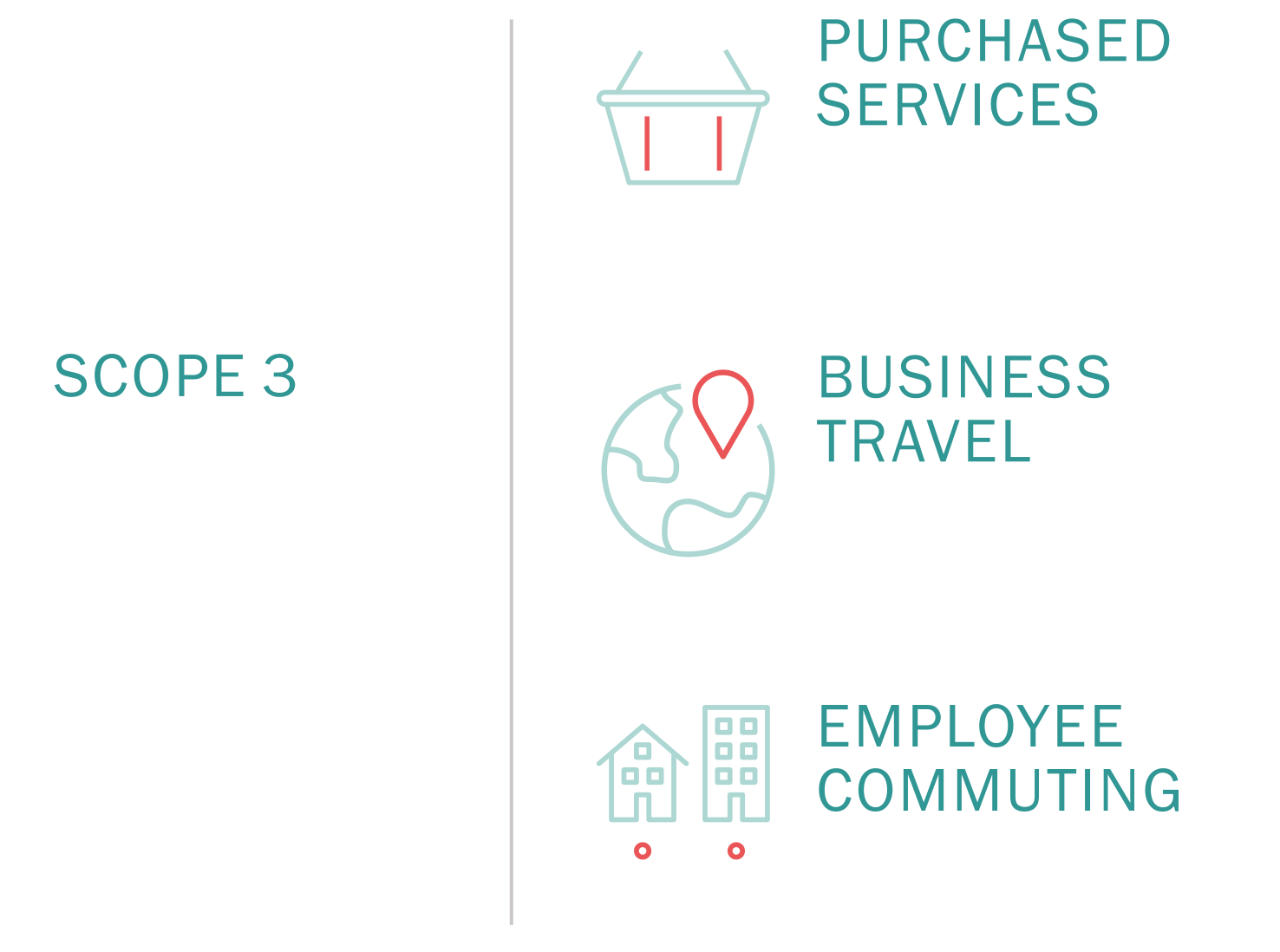
In fact, in 2024, 99% of our emissions were Scope 3, which means most of our impact lies in areas outside our direct control — such as purchased goods and services, business travel, and employee commuting. These three categories together account for nearly 90% of our total footprint, making them our top priorities.
To address this, we are focusing on collaboration with suppliers and colleagues to reduce emissions in these hotspots.
Total emissions reduction
Movement year on year
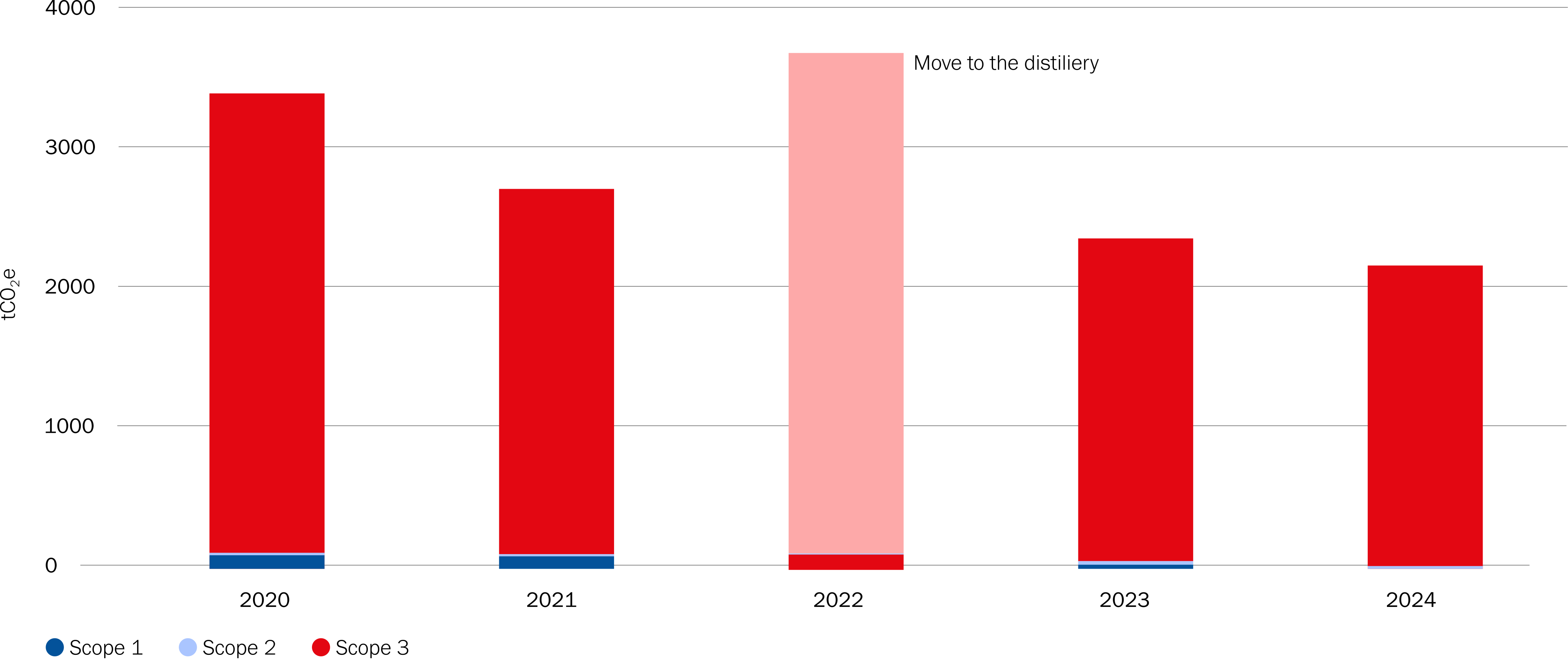
Since 2000, we have continuously reduced our carbon footprint year-on-year with 2022 standing out as anomalous due to our move to a new headquarters in Bristol. The office move drove additional expenditure as we had to temporarily operate two office locations simultaneously. However, our new office is significantly more environmentally friendly, designed to reduce energy consumption and support sustainable practices for the long term.
We continue to review our estate footprint based on business needs, ensuring our spaces align with our sustainability goals. We have further reduced our impact by closing our U.S. office where we transitioned to a fully remote model.
Our 2024 carbon footprint was 2172 tCO₂e, an 8% reduction from 2023 and a 36% drop compared to our 2020 baseline. This progress reflects our ongoing commitment to sustainability and the impact of the choices we have made across the business.
-36%
CO₂ reduction from 2020 to 2024
Moving away from print
Print was a major source of emissions in our operations, stemming from material use and logistics. By adopting a digital-first publishing approach, we eliminated journal print subscriptions and transitioned international IOP members to Physics World digital access. This change significantly reduced carbon emissions tied to physical product production and decreased our use of Earth’s resources. It also removes the need to ship physical copies to consumers and customers. Notably, air freight, a key contributor to distribution emissions, has been nearly eliminated, dropping from 305 tCO₂e in 2022 to almost zero.
In 2024 alone, this change reduced emissions by nearly 170 tCO₂e, equivalent to almost 8% of our total footprint, demonstrating how strategic decisions and digital innovation can deliver substantial environmental benefits.
89%Reduction in emissions from print materials for journals
59%Reduction in emissions from outbound logistics for journals
58%Reduction in emissions from print materials for Physics World
74%Reduction in emissions from outbound logistics for Physics World
Travel policy for a greener future
To reduce emissions from business travel, we have introduced a policy that limits trips to essential travel only and prioritizes sustainable options such as choosing trains over flights. We have also introduced a range of green travel initiatives—including cycling support, electric pool bikes, and personalized travel planning to help us lower emissions associated with employee commuting.

Supply chain management
Our vision is to create a sustainable supply chain that not only meets the needs of today but also ensures a better future for generations to come. By integrating sustainable practices into every aspect of our supply chain, we aim to reduce our environmental footprint, promote ethical sourcing and foster innovation. We believe that a sustainable supply chain is not just a responsibility, but an opportunity to lead by example, inspire our colleagues, and contribute to a more sustainable world. Together, we can make a significant impact and drive positive change within our industry and beyond.
Supply Chain Working Group
The Supply Chain Working Group is committed to advancing sustainability across our supplier network by setting a clear expectation that sustainability is a key focus for us and also promoting adherence to our Supplier Code of Conduct. It also supports Supplier Relationship Owners across the business in encouraging suppliers to prioritize taking action on their carbon footprint and other environmental activities.
Annual assessment
Our Supplier Relationship Owners work closely with suppliers both day-to-day and through an annual supply chain assessment process. This assessment asks suppliers to share information on their environmental commitments and policies, greenhouse gas emissions, renewable energy usage, resource efficiency, and water and waste management. We also collect primary data on Scope 1 and 2 emissions attributable to us, which contribute to our corporate carbon footprint. The goal of this engagement is to raise awareness of carbon emissions across our supply chain and drive greater transparency around the environmental impact of our operations.
Key results from our 2025 assessment:
- 116 suppliers were invited to complete the sustainability questionnaire
- 30% of suppliers currently measure their carbon footprint
- 4 suppliers were able to provide estimated attribution of Scope 1 and 2 emissions to IOPP activities
Materials usage
Alongside reducing the manufacture of physical products, we have guidelines in place to support colleagues in their decisions on materials that consider geography, biodiversity, greenhouse gas emissions, plastic content, water consumption and recyclability. We have also introduced clear guidance to ensure all promotional merchandise is sourced and produced responsibly. This includes environmental, social and ethical considerations across procurement, distribution and supplier engagement.
Content and products
Supporting the UN Sustainable Development Goals
As a signatory of the UN Sustainable Development Goals (SDG) Publishers Compact, we support the UN SDGs by actively promoting and acquiring content that advocates for the key themes represented by the SDGs. We also provide free access to research on sustainability and equity through our Sustainability Collection. This collection now includes 10,500 freely accessible articles, which have been downloaded 7.5 million times.
Publishing solutions for global sustainability challenges
We have grown our Environmental Research series™ which is an evolving network of open access journals addressing the critical challenges relating to the environment and sustainability, sharing knowledge and driving innovation to cultivate a brighter, greener future for all. The series now includes nine titles covering all areas of environmental science, from interdisciplinary environmental research to more focused journals covering climate, ecology, energy, food systems, health, infrastructure and water.
We have also launched Sustainability Science and Technology, a new, interdisciplinary, open access journal dedicated to advancing sustainability through cutting-edge research in science, technology and engineering. The new journal brings together researchers from diverse disciplines across engineering, chemistry, physics, materials science and environmental science to address global challenges and contribute to a more sustainable future.
Sustainable workplaces

The Distillery
Moving our headquarters to The Distillery in Bristol was a major step in reducing our carbon emissions in the long term. While the transition temporarily increased emissions as we operated two offices simultaneously, the new space has a much lower environmental impact as it is highly energy-efficient and powered by clean energy. This has resulted in a reduction of over 80% in our Scope 1 and Scope 2 emissions since 2020.
Water usage
Our commitment to sustainability extends across all our workplaces—not just our new head office. We have implemented water-saving measures in every office, including efficient dishwashers, flow restrictors on taps, and water-saving systems in all toilets. In addition, leak detection systems are in place to prevent unnecessary waste and ensure responsible water use.
Waste management
Our waste strategy prioritizes recycling and energy recovery. We recycle electronics and lighting in compliance with WEEE regulations, compost food waste, and recycle materials such as paper, metal, cardboard, plastic, ink cartridges, batteries and glass. Non-recyclables are sent to an energy recovery facility, and our café aims for zero waste by redistributing unsold food. We even reused meeting room doors when we moved offices.
Consumables
We actively avoid single-use plastics and choose sustainable alternatives for office supplies. Staff passes are printed on recycled eco cards, coffee is served in reusable Huskie cups, and all printer paper is 100% recycled and FSC-approved. We also source plastic-free tea bags, recyclable Jiffy bags and other environmentally friendly products.
Cleaning
Our cleaning practices meet ISO14001 standards and use non-polluting, low-impact chemicals. We provide FSC-certified toilet paper, biodegradable soap and non-aerosol air fresheners. Sanitary waste is sent to waste-to-energy plants and we work with local suppliers for window and carpet cleaning. Even pest control is chemical-free, using natural methods to maintain a healthy environment.
ISO 14001 certification
In 2024, we achieved ISO 14001 Environmental Management Systems certification, demonstrating that we have robust, clearly defined environmental processes in place. This recognition supports our customers’ and partners’ expectations, and ensures we continue to improve resource efficiency and reduce environmental impact across all business areas.

Engaging our colleagues at home and at work
IOP for Environmental Change
Launched in 2022, the IOP for Environmental Change campaign helps colleagues consider the environmental impact of both our organisation and individual actions. It raises awareness of how we can tackle the climate crisis, featuring world-leading environmentalists and activists as guest speakers.
Key topics and speakers have included:
- Laura Young, known as ‘Waste Less Laura’, about how to live with less waste.
- Climate change expert Mark Maslin, about the science and politics of climate change.
- Jojo Mehta, regular speaker at United Nations summits, about Stop Ecocide International which aims to make the mass destruction of ecosystems a prosecutable, international crime against peace.
- Being Water Wise with Giki
- Taking a Bite Out of Our Food Footprints
- Greener Travel
- Waste at Work
- The Big Switch
Personal Carbon Calculator
To encourage personal action, we introduced Giki Zero, a tool that helps individuals understand their carbon footprint and take practical steps to reduce it. Many colleagues have made changes that contributed to lowering our overall impact.
In 2024, several colleagues took part in challenges like the Employee Race to Zero, a global two-week sustainability competition. Over 30 organisations completed 5,307 activities, avoiding 33,960 kg of carbon—the equivalent of 890 short-haul flights. Our team placed 9th, completing 71 steps and taking 202 actions.
We continue to build awareness, encourage behaviour change and embed sustainability into our culture.
Volunteering for the environment
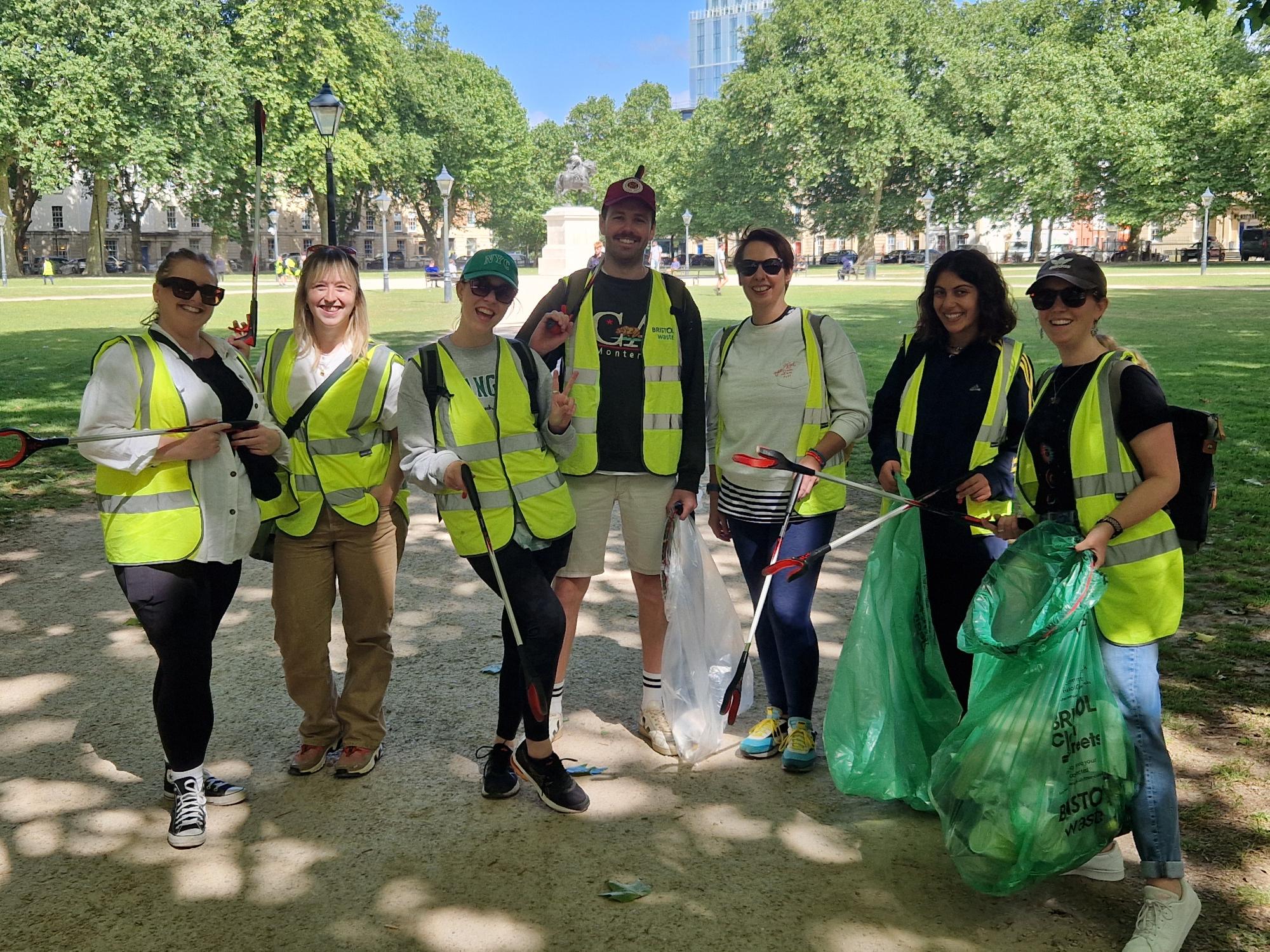
Colleagues use their volunteering days to support environmental charities worldwide. In Bristol, teams took to the streets for a litter pick, while in China colleagues waded through rivers to clear debris. Others helped remove invasive plant species in wetlands near Bristol, and in the US, teams joined local conservation projects. These efforts reflect our commitment to making a positive impact on the environment locally and globally.
Next steps
Looking ahead, we are focused on three key actions to drive further reductions:
1
We will maintain momentum on our digital transformation, reducing reliance on print and further cutting emissions linked to production and distribution.
2
We will continue working closely with suppliers to improve data accuracy and identify opportunities for emissions reduction across our supply chain.
3
We will continue to support colleagues to develop their knowledge and understanding to make sustainable choices for travel and commuting, and to support behaviours that minimize environmental impact.
“Together, these efforts will help us build on the progress we’ve already made and move closer to our long-term sustainability goals.”
Liz Martin, Head of Content Production and Sustainability Lead